
Events
-
-

IEEE SPICE Talk@TUM 12 Sep 2025
München Technical University of Munich, München, GermanySPICE stands for Simulation Program with Integrated Circuit Emphasis, while integrated circuit design is a domain where computer-aided design (CAD) is mandatory. Most commercial versions of SPICE are based on SPICE2, specifically the G6 version from the University of California, Berkeley. The material presented in the workshop will cover a brief history of SPICE, its main objectives, analysis types, algorithms, and key convergence topics. The newest research directions will also be addressed. A wide audience from industry and academia is expected to show a great interest in the Workshop Prof. Andrei Vladimirescu U.C. Berkeley AGENDA IEEE Presentation: 9:30 - 9:45 SPICE (Part I): 9:45 - 12:00 Coffee Break: 12:00 - 12:30 SPICE (Part II): 12:30 - 13:30 Q & A Session: 13:30 – 14:00 Where? Technische Universität München Theresienstr. 90, Gebäude N3, 5. St, Raum N5325 80333 München
-
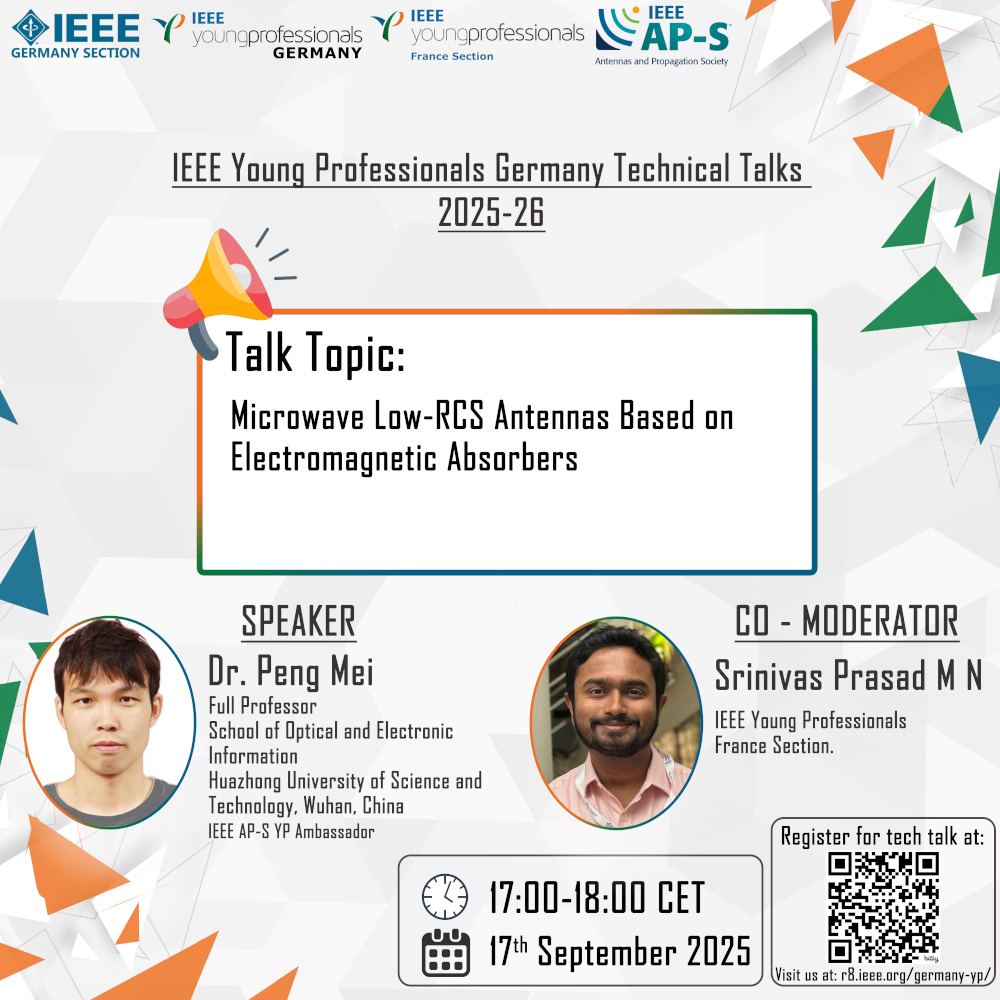
Microwave Low-RCS Antennas Based on Electromagnetic Absorbers
Online , GermanySpeaker: Dr. Peng Mei Full Professor School of Optical and Electronic Information, Huazhong University of Science and Technology, Wuhan, China IEEE AP-S YP Ambassador Moderator & Organizer: Sevda Abadpor (YP Germany section) Co-Moderator: Srinivas Prasad MN (YP France Section) Title of Talk: Microwave Low-RCS Antennas Based on Electromagnetic Absorbers When: 17th September 2025 at 5:00 pm CEST (Time zone: Europe/Berlin) Where: Google Meet joining info. after registration via: https://bit.ly/4p1Dg2r
-
-
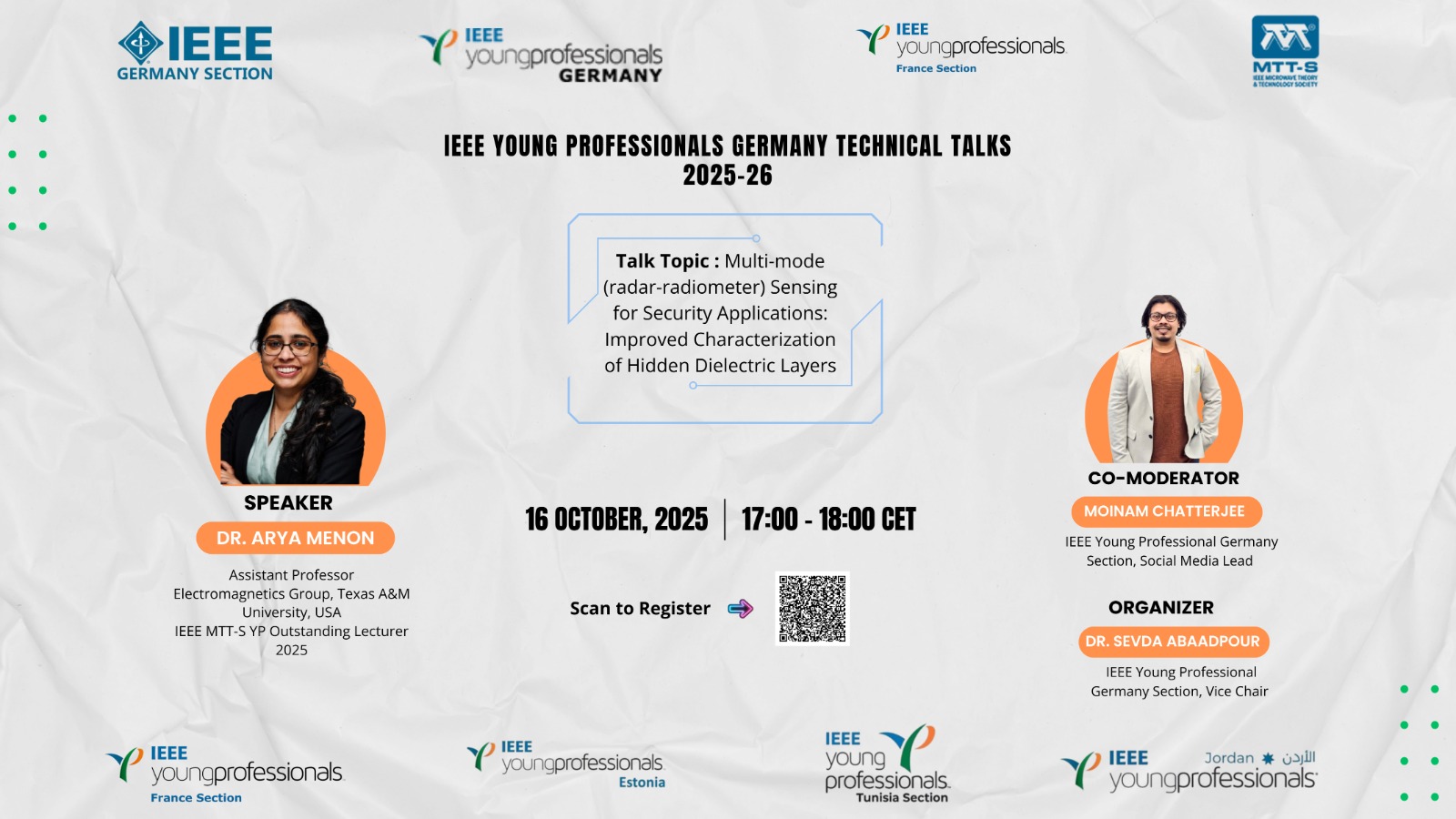
Multi-mode (radar-radiometer) Sensing for Security Applications: Improved Characterization of Hidden Dielectric Layers
Speaker: Dr. Arya Menon Assistant Professor Electromagnetics Group, Texas A&M University, USA IEEE MTT-S YP Outstanding Lecturer Title of Talk: Multi-mode (radar-radiometer) Sensing for Security Applications: Improved Characterization of Hidden Dielectric Layers When: ⏰ Thursday, October 16 · 5:00 – 6:00pm Time zone: Europe/Berlin Co-Moderator: Moinam Chatterjee ( IEEE YP Germany Section) Organizer & Moderator: Sevda Abaadpour (IEEE YP Germany Section) 🪧 𝗧𝗵𝗲 𝗹𝗶𝗻𝗸 𝘁𝗼 𝗿𝗲𝗴𝗶𝘀𝘁𝗲𝗿 𝗳𝗼𝗿 𝘁𝗵𝗲 𝗲𝘃𝗲𝗻𝘁 𝗶𝘀: 1)IEEE vTools Event: https://lnkd.in/daAuDT2g 2) Eventbrite: IEEE YP Tech Talk/ Dr. Arya Menon: https://shorturl.at/jVYJX
-
2025 EMV Boot Camp – Fokus: EMV am Antriebsstrang
Hamburg , GermanyAirbus Kreetslag 10 21129 Hamburg-Finkenwerder 14. + 15.10.2025 Event Details
-
The 50th IEEE Conference on Local Computer Networks (LCN) October 14-16, 2025, Sydney, Australia
The IEEE LCN conference is the premier conference on theoretical and practical aspects of computer networking. LCN is highly interactive, enabling an effective interchange of results and ideas among researchers, users, and product developers. Major developments from high-speed networks to the global Internet to specialized sensor networks have been reported at past LCNs. Please join us for LCN 2025, our 50th annual meeting, in Sydney, Australia! https://www.ieeelcn.org/ Important Dates Paper Registration: April 20, 2025 (AoE) Paper Submission: April 27, 2025 (AoE) Paper Acceptance Notification: July 1, 2025 (AoE) Final Paper Due: August 1, 2025 (AoE)
-

IEEE EMC Young Professional Day
Meet and connect with fellow young professionals during this year’s IEEE Young Professionals Event in Berlin, Germany. Participate in a guided tour at the Fraunhofer Institute for Reliability and Microintegration (Fraunhofer IZM) which includes a look at their anechoic chamber, power electronics lab, and packaging & prototyping line. Join us for our social event afterwards! Date: 23.10.2025 Event Details
-
-

Aller guten Dinge sind drei: Drei EMV-Professionals @ 3M
NeussSchirmungsaspekte im Automobilbereich IEEE EMC Society German Chapter zu Gast bei 3M Carl-Schurz-Str. 1, 41453 Neuss 06.11.2025, 12:00 – 17:00 CEST Event Details
-
-
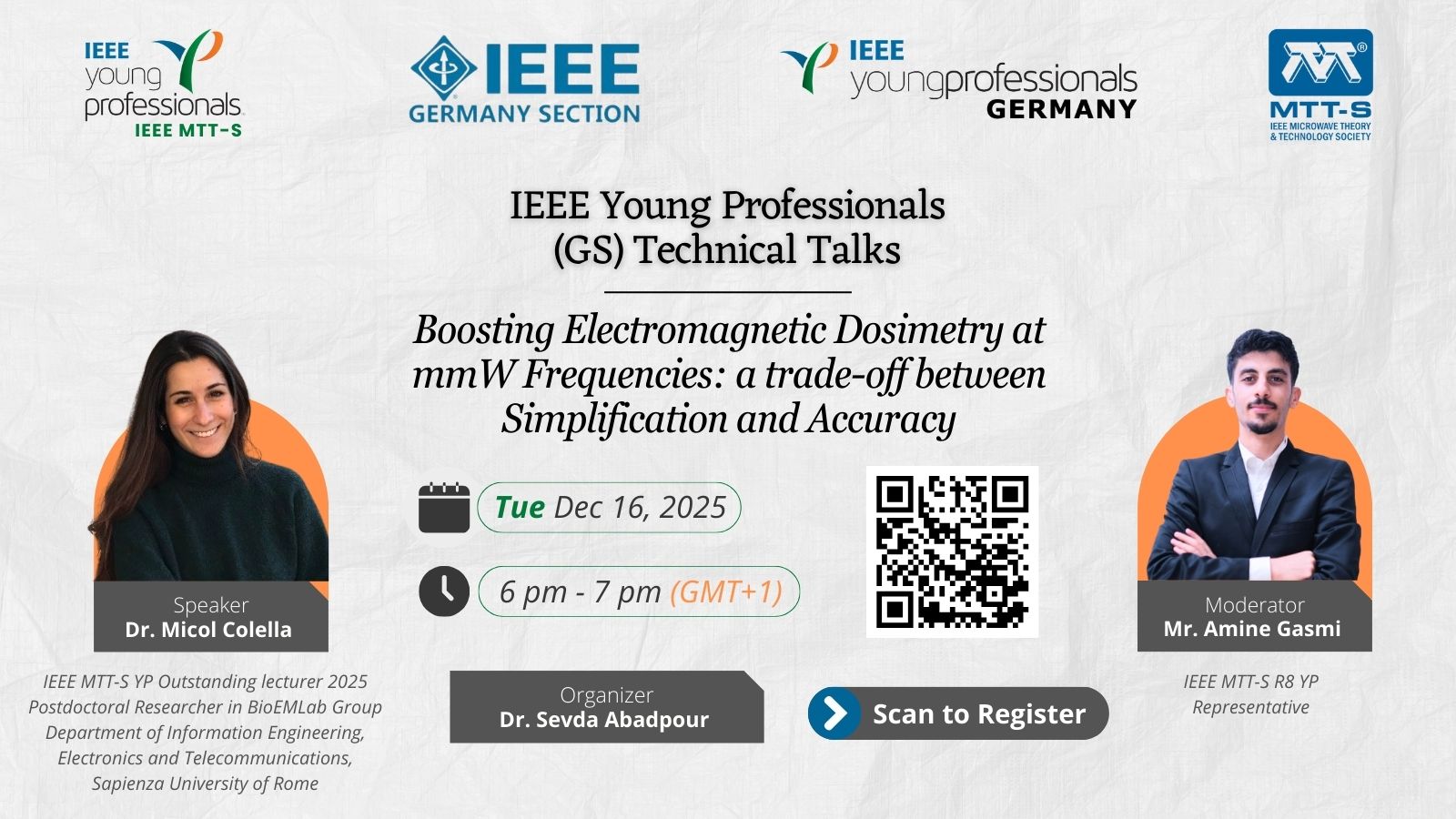
Boosting Electromagnetic Dosimetry at mmW Frequencies: a trade-off between Simplification and Accuracy
Speaker: Dr. Micol Colella, IEEE MTT-S YP Outstanding lecturer 2025 Postdoctoral Researcher in the Bioelectromagnetics Lab (Department of Information Engineering, Electronics and Telecommunications, Sapienza University of Rome, Italy). Title of Talk: Boosting Electromagnetic Dosimetry at mmW Frequencies: a trade-off between Simplification and Accuracy When: ⏰ Tuesday, December 16 · 6:00 – 76:00pm Time zone: Europe/Berlin Co-Moderator: Amine Gasmi, (IEEE MTT-S R8 YP Representative) Organizer & Moderator: Sevda Abaadpour (IEEE YP Germany Section) 🪧 𝗧𝗵𝗲 𝗹𝗶𝗻𝗸 𝘁𝗼 𝗿𝗲𝗴𝗶𝘀𝘁𝗲𝗿 𝗳𝗼𝗿 𝘁𝗵𝗲 𝗲𝘃𝗲𝗻𝘁 𝗶𝘀: IEEE vTools Event: https://events.vtools.ieee.org/m/516196
-
-
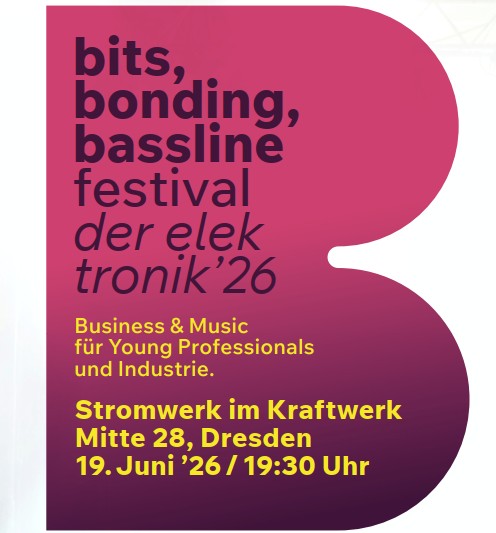
bits, bonding, bassline Festival der Elektronik 2026
Dresden , Germanybits, bonding, bassline Festival der Elektronik Fr., 19. Juni 2026 im Dresdner Stromwerk https://www.bits-bonding-bassline.com/
-
-

IEEE RAS Summer School in Germany 2026
Abtei FrauenwörthFirst Call for Applications and SAVE THE DATE!!! The IEEE Robotics and Automation Society (RAS) German Chapter is pleased to announce the IEEE RAS Summer School on Cognitive Robotics, taking place from September 7–11, 2026, at the historic Abtei Frauenwörth, Chiemsee, Germany. About the Summer School Robotics has rapidly evolved from laboratory research into a transformative technology impacting manufacturing, healthcare, mobility, civil security, and everyday life. At the same time, recent advances in Artificial Intelligence (AI) have unlocked unprecedented capabilities for autonomous systems. While AI techniques for perception and vision-based action are now widely adopted in robotics, the integration of higher-level cognitive capabilities for long-horizon and long-term autonomy—such as decision making, automated planning, continual learning, task and motion integration, and human-AI interaction—remains one of the most exciting and open research frontiers. This Summer School brings together leading researchers from AI and robotics to explore the foundations and future of cognitive robotics. Participants will gain insights into state-of-the-art methods that enable robots to reason, learn, interact, and pursue goals in dynamic, uncertain, and human-centered environments. Beyond the lectures, the Summer School offers a unique opportunity to: Learn directly from internationally renowned experts, Discuss research ideas in an intimate and highly interactive setting, Build connections with fellow students, researchers, and practitioners, Engage with successful entrepreneurs working at the forefront of robotics and automation. How to Apply Applications must be submitted by July 10, 2026 via the following Google Form: https://forms.gle/qPg2g3J8QYWgaarz6 As part of the application, you will be asked to provide: A Curriculum Vitae (CV) in PDF format (uploaded through the form), A short statement of motivation explaining why the Summer School is relevant to your interests, studies, research, or professional activities. Selection and Participation Fee The Summer School is limited to 40 participants, ensuring an engaging learning experience with ample opportunities for interaction with lecturers and fellow attendees. Participants will be selected primarily based on their motivation and the relevance of the Summer School to their academic, research, or professional goals. We are committed to fostering a diverse and inclusive cohort and warmly encourage applications from individuals with a broad range of technical backgrounds. Successful applicants will be invited to confirm their participation through registration and payment of the participation fee. While attendance at all lectures and scientific activities is free of charge, the participation fee covers: Accommodation (September 6–11, 2026), Meals, Coffee breaks, Social activities during the Summer School. The participation fee will not exceed: €800 for non-students, €700 for students. IEEE members are eligible for additional discounts. We are actively pursuing further sponsorship opportunities and will make every effort to reduce the participation fee. The amounts listed above represent the maximum fees, and the final fees may be lower once registration opens. Confirmed Lecturers We are currently expanding the programme, but are delighted to already announce the following confirmed speakers, whose lectures will cover a broad spectrum of topics, ranging from automated planning and reasoning to the integration of high-level task reasoning with low-level motion planning, as well as state-of-the-art machine learning techniques for robotics. Brian Williams – Professor, Computer Science and Artificial Intelligence Laboratory (CSAIL), Massachusetts Institute of Technology (MIT) Hector Geffner – Professor, Chair of Machine Learning and Reasoning, RWTH Aachen University Hermann Blum – Professor for Robot Perception and Learning, Lamarr Institute/University of Bonn Jan Peters – Professor for Intelligent Autonomous Systems, TU Darmstadt João Silvério – Head of the Interactive Skill Learning Group, German Aerospace Center (DLR) Majid Khadiv – Professor for AI Planning in Dynamic Environments, Technical University of Munich (TUM) Marc Toussaint – Professor for AI and Robotics, TU Berlin Rudolf Lioutikov – Professor, Intuitive Robots Lab, Karlsruhe Institute of Technology (KIT) Additional speakers will be announced soon. Further Information For additional information, please visit: https://r8.ieee.org/germany-ras/2026/05/11/ieee-ras-german-summer-schools-2026/ If you cannot find the information you are looking for, please do not hesitate to contact us. We look forward to welcoming you to Chiemsee in September 2026! IEEE RAS German Chapter Summer School Organising Committee